
Fiber and Integrated Optics Laboratory
Fiber Optics
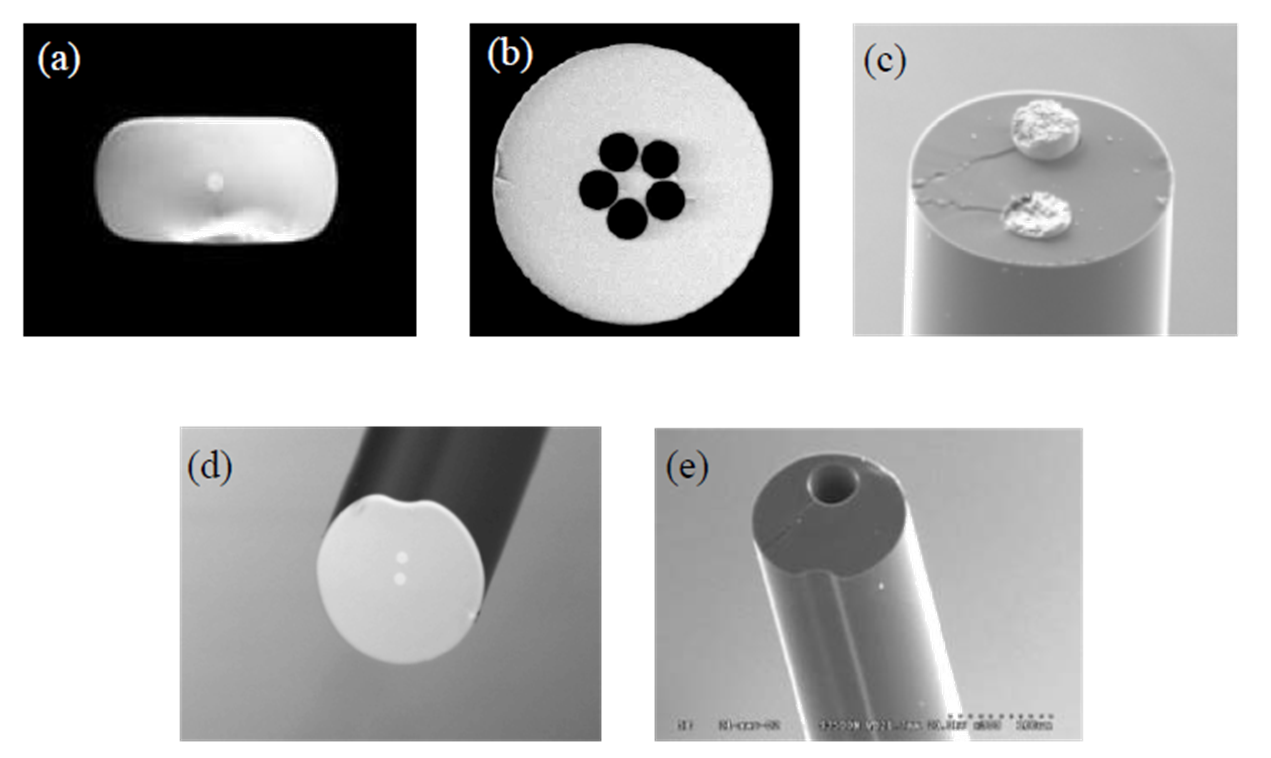
Fiber-optic devices are essential components of modern optical technology, enabling the transmission, control, and manipulation of light. This is related to the fact that optical fibers are immune to electromagnetic interference, lightweight, and capable of carrying extremely large amounts of information, they have become a key technology in many modern systems. Although commercial fibers can be used for several applications, we focus our research on specialty fibers because we can tailor them to specific applications. Specialty fibers, such as the one shown in the figure below, are provided through collaborations with overseas research groups.
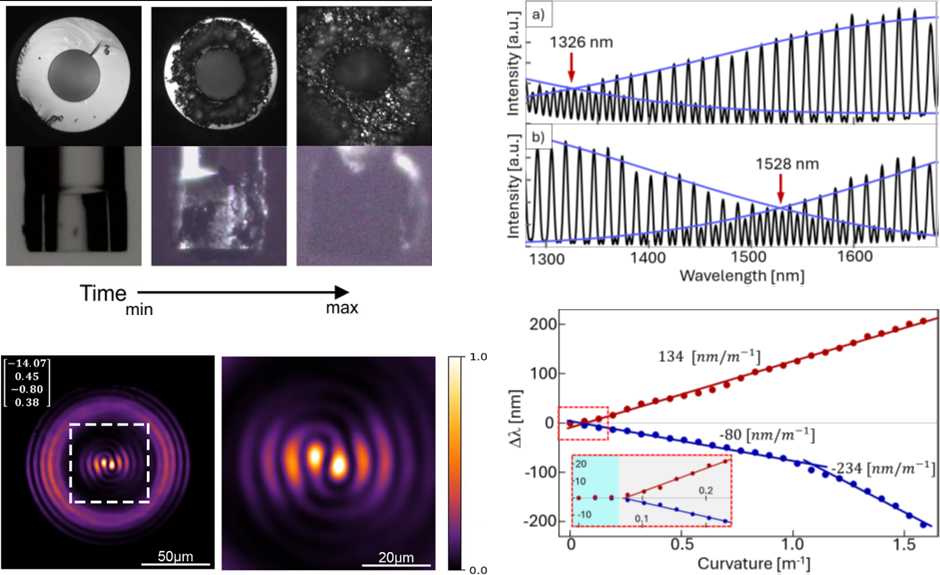
Fiber optics plays a crucial role in sensor applications. Fiber optic sensors measure physical, chemical, or environmental parameters by detecting changes in light traveling through the fiber. These sensors can detect variations in temperature, pressure, strain, vibration, or chemical composition. For example, a change in temperature may alter the fiber's refractive index or length, thereby changing the phase or intensity of the transmitted light. These changes can be measured and converted into useful data. Fiber optic sensors are especially valuable in harsh environments where traditional electrical sensors might fail, such as high-voltage areas, oil wells, aircraft structures, and biomedical monitoring systems. We develop fiber-optic sensors for different applications, based on specialty fibers, where the special geometry allows us to obtain highly sensitive sensors.
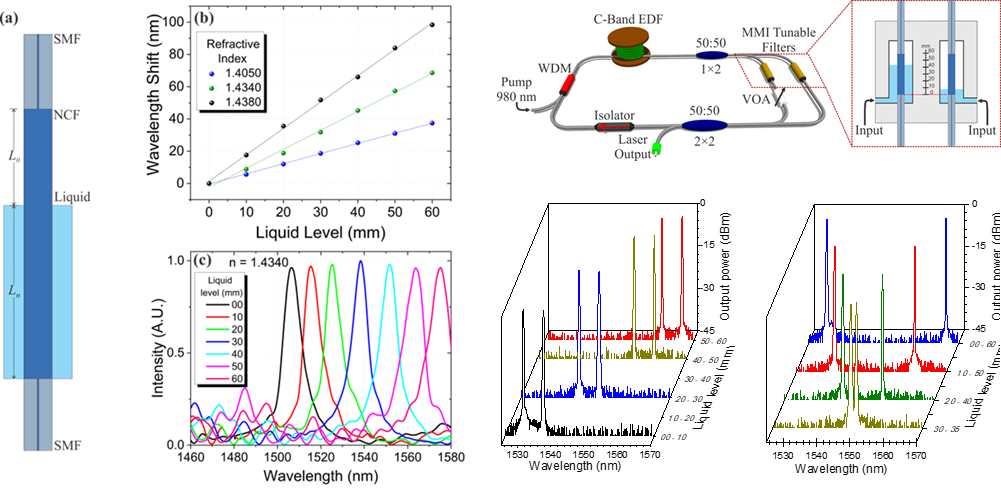
Another important application is the development of fiber-optic lasers, particularly tunable fiber laser systems. Optical fibers provide an excellent medium for developing tunable lasers because their emission can be selected by appropriate doping. Rare-earth elements such as erbium or ytterbium are often doped into the fiber to amplify light when pumped by another light source. It allows the use of already-developed commercial fiber-optic devices, such as couplers, splitters, and modulators, which aid in controlling the laser operation mechanism. Fiber lasers are widely used in industrial cutting, welding, medical procedures, and scientific research because they provide high beam quality, stability, and efficiency.
In conclusion, fiber optic devices are vital tools in both laser technology and sensing applications. Their ability to efficiently transmit light, resist interference, and operate in demanding environments makes them ideal for advanced scientific, industrial, and medical systems. As optical technology continues to evolve, fiber optic devices will remain central to innovations in lasers, precision measurements, and intelligent sensing systems.